
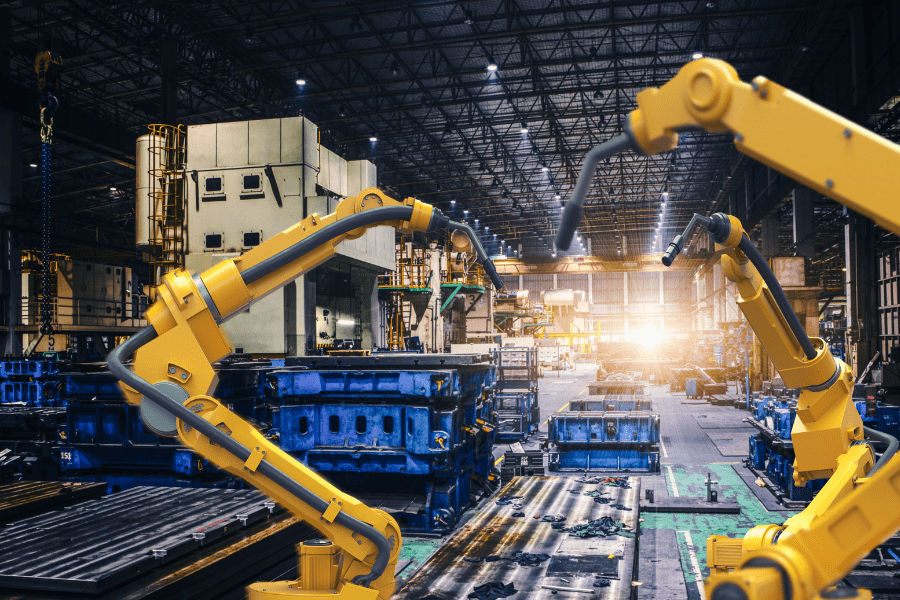
The global manufacturing sector is undergoing its most profound structural transformation since the introduction of assembly-line automation in the twentieth century. Historically, industrial progress was measured by the raw mechanical power of machinery, the physical footprint of production facilities, and the manual dexterity of human labor. Today, the definition of industrial excellence has shifted from physical muscle to digital intelligence.
The integration of the Industrial Internet of Things, advanced robotics, edge computing, and artificial intelligence has given rise to the smart factory. This transition, collectively known as Industry 4.0, represents a fundamental decoupling from legacy, siloed manufacturing methodologies. Modern industrial operations are evolutionarily adapting into interconnected, autonomous, and self-optimizing ecosystems capable of predicting failures, adjusting to supply chain fluctuations in real time, and delivering hyper-customized products at mass-production costs.
The Architectural Pillars of Industry 4.0
The modern smart factory does not rely on a single breakthrough technology. Instead, it is an intricate convergence of multiple digital systems functioning as a cohesive operational layer. Understanding how these separate technologies integrate is essential for analyzing the modern industrial landscape.
-
The Industrial Internet of Things: Legacy factory floors featured isolated machines that stored operational data internally or discarded it entirely. The Industrial Internet of Things blankets the manufacturing environment with thousands of smart sensors that continuously monitor thermal variations, acoustic anomalies, vibrational frequencies, and operational cycle times. This continuous stream of telemetry transforms passive physical assets into dynamic data generators.
-
Cyber-Physical Systems and Digital Twins: A digital twin is a highly sophisticated, real-time virtual replica of a physical machine, production line, or entire manufacturing facility. By feeding live sensor data into these virtual models, industrial engineers can run predictive simulations, stress-test operational modifications, and identify hidden bottlenecks without risking physical hardware or halting active production.
-
Edge Computing and Cloud Infrastructure: The massive volume of data generated by factory sensors makes transferring all information to a centralized cloud infrastructure inefficient and costly. Edge computing solves this latency problem by processing critical data directly on the factory floor near the physical asset. Time-sensitive anomalies trigger immediate machine shutdowns at the edge, while long-term performance data is aggregated and sent to the cloud for deep macro-analysis.
-
Autonomous Mobile Robots and Advanced Automation: Unlike traditional, fixed assembly-line robots that execute rigid, pre-programmed paths, modern autonomous mobile robots navigate dynamic factory environments independently. Using advanced computer vision and localized mapping algorithms, these machines transport raw materials, manage inventory layouts, and collaborate safely alongside human operators.
The Transition from Reactive to Predictive Maintenance
For generations, industrial facilities operated on a break-fix or calendar-based maintenance schedule. Reactive maintenance required running a machine until a catastrophic mechanical failure occurred, leading to expensive emergency repairs, extensive unplanned downtime, and disrupted supply chains. Preventive maintenance mitigated this somewhat by replacing parts on a rigid chronological timeline, though this frequently resulted in discarding perfectly functional components.
The data infrastructure of Industry 4.0 enables absolute predictive maintenance. By leveraging machine learning models trained on historical performance anomalies, smart factories can detect microscopic signs of mechanical degradation long before an actual failure manifests.
For instance, a subtle increase in the vibrational frequency of a high-speed turbine, undetectable to a human operator, is instantly flagged by predictive algorithms. The system automatically cross-references inventory logs to ensure replacement parts are available, schedules a maintenance window during a natural production lull, and assigns the repair task to a technician. This optimization dramatically extends the operational lifespan of capital assets, lowers maintenance overhead, and eliminates the unpredictability of factory floor downtime.
Decentralized Production and the Mass Customization Paradox
Historically, manufacturing efficiency was dictated by the economies of scale. To achieve a low per-unit cost, factories had to produce thousands of identical items via rigid, unyielding tooling configurations. Modifying a product line to accommodate custom consumer preferences required manual re-tooling, a process that took days and incurred prohibitive capital expenses.
Smart factories resolve this tension through algorithmic, decentralized production frameworks. Advanced automation systems feature modular, software-defined tooling that adjusts dynamically on the fly. As an item moves down an automated assembly line, radio-frequency identification tags communicate custom build specifications directly to individual robotic workstations.
This integration allows a single production line to seamlessly manufacture unique, customized variations of a product consecutively without stopping the line or requiring manual intervention. Mass customization shifts the competitive landscape, allowing agile manufacturers to command premium pricing for personalized goods while maintaining the operational cost efficiencies historically exclusive to standardized mass production.
Supply Chain Synchronicity and Cognitive Logistics
The boundaries of a modern industrial enterprise extend far beyond the physical walls of the factory floor. Legacy industrial operations frequently suffered from severe data lag, where manufacturing schedules were decoupled from real-time global logistics and raw material availability. This misalignment led to either expensive inventory surpluses or critical component shortages.
Industry 4.0 establishes total cognitive synchronicity across the entire value chain. Enterprise resource planning systems are directly integrated with supplier databases, global shipping trackers, and real-time consumer demand signals.
When an unexpected geopolitical event or climate disruption delays a raw material shipment, the factory’s cognitive architecture instantly calculates the operational impact. The system automatically reschedules production priorities, shifts manufacturing capacity to alternative product lines that utilize available inventory, and alerts downstream distribution partners of revised delivery timelines. This level of algorithmic adaptability insulates industrial organizations from macroeconomic volatility and guarantees continuous operational continuity.
Decarbonization and the Green Industrial Factory
Industrial manufacturing has historically been a primary driver of global carbon emissions and resource depletion. As regulatory frameworks tighten and consumers demand environmental accountability, modern industry is leveraging digital transformation to achieve aggressive sustainability goals.
Smart factories utilize artificial intelligence to execute deep energy optimization strategies. Environmental sensors track the precise energy consumption profiles of every machine tool, heating element, and ventilation system on the factory floor. AI algorithms process this data to identify hidden energy waste, automatically shifting heavy power-consumption activities to off-peak hours when renewable energy is more abundant on the electrical grid.
Furthermore, advanced data analytics minimize raw material waste by optimizing cutting patterns, improving chemical formulations, and predicting production defects before scrap material is created. By intertwining digital efficiency with environmental stewardship, modern industrial operations prove that ecological sustainability and corporate profitability are no longer mutually exclusive objectives.
The Future Blueprint: Cognitive Industrial Ecosystems
The ultimate realization of Industry 4.0 is not merely an automated factory floor, but a completely autonomous cognitive industrial ecosystem. In this future paradigm, human workers step away from repetitive, hazardous physical tasks and move into roles centered around strategic system architecture, ethical data governance, and high-level collaborative design. The organizations that successfully master this convergence of physical machinery and digital intelligence will define the global economic landscape, leaving legacy manufacturers unable to compete on speed, cost, flexibility, or quality.
Frequently Asked Questions
What is the primary difference between traditional industrial automation and Industry 4.0?
Traditional industrial automation focuses on programming individual machines to perform repetitive, static tasks at high speeds without human intervention. Industry 4.0 goes a step further by connecting those automated machines into a centralized, intelligent data network, enabling self-optimization, real-time communication, and autonomous decision-making across the entire facility.
How do industrial organizations protect smart factories from advanced cybersecurity threats?
Smart factories deploy robust defense-in-depth cybersecurity frameworks to protect their operational technology networks. This involves isolating critical manufacturing machinery from the public internet using secure industrial demilitarized zones, implementing strict zero-trust network access controls, deploying edge-based anomaly detection systems, and continuously updating firmware across all connected internet-of-things devices.
Can legacy manufacturing facilities be retrofitted to participate in Industry 4.0?
Yes, transitioning to a smart factory does not require completely discarding legacy machinery. Industrial firms frequently use cost-effective retrofitting strategies, installing external non-invasive sensors onto older equipment to track vibration, temperature, and power draw. These sensors feed data into modern edge-computing gateways, bringing legacy assets directly into the connected digital ecosystem.
What is dark manufacturing, and how close is the industry to achieving it?
Dark manufacturing, also known as lights-out manufacturing, refers to production facilities that function completely autonomously without human intervention on-site, allowing operations to run in the dark without heating or cooling. While some highly specialized sectors like semiconductor fabrication or basic plastics injection molding achieve near-continuous lights-out operations, most industries still require human personnel for strategic maintenance, quality assurance audits, and complex oversight.
How does computer vision improve quality control on the modern assembly line?
Traditional quality control relies on manual human inspections or spot-checking a fraction of finished goods. Computer vision systems utilize high-resolution cameras paired with deep-learning algorithms to scan every single product moving down an assembly line in real time, instantly detecting microscopic surface blemishes, structural fractures, or dimensional deviations that are completely invisible to the human eye.
What role does 5G connectivity play in the deployment of smart factory architecture?
Modern industrial floors require wireless networks that can handle thousands of data-generating devices simultaneously with virtually zero latency. Private 5G networks provide the necessary bandwidth, ultra-low latency, and network slicing capabilities required to coordinate rapid autonomous mobile robots, transmit high-fidelity digital twin data streams, and support augmented reality headsets used by maintenance technicians.