
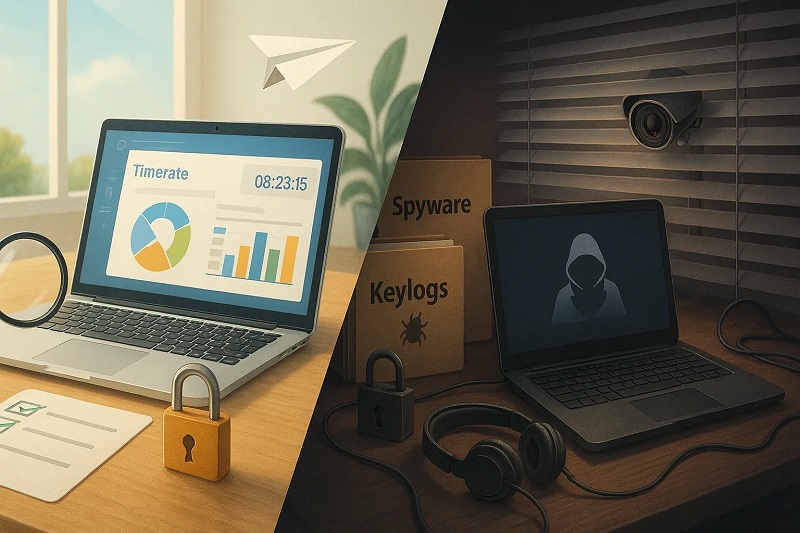
When distributed work moved from an experimental perk to an everyday operational reality, it exposed an uncomfortable truth about traditional management: many leaders had spent decades confusing physical presence with genuine contribution. In an office, an employee sitting upright at a desk, staring intently at a monitor, and walking briskly between conference rooms projects the convincing aura of hard work. Take away the cubicle walls, however, and that visual shorthand disappears entirely.
In the vacuum left by physical oversight, a troubling software category found eager buyers. Employee monitoring software—often categorized more bluntly as bossware—promised nervous executives total visibility through keystroke logging, random webcam snapshots, automated screen recording, and mouse-movement tracking.
The promise was simple, but the premise was broken. Surveillance tools do not measure productivity. They measure compliance with arbitrary activity signals. The moment a company installs software to monitor physical inputs, it encourages its workforce to optimize for those exact inputs rather than actual business results.
The Flawed Mechanics of Activity Tracking
Monitoring tools operate on a fundamentally flawed assumption: that knowledge work is linear, continuous, and directly correlated with physical interaction with an input device. Anyone who solves complex technical problems, designs marketing strategies, or writes code knows this is fiction.
An engineer might spend two hours pacing across their living room staring at a whiteboard, mentally mapping out an architectural database schema that will save the company months of rework. To a keystroke logger, that engineer is effectively delinquent. Conversely, an employee can easily defeat basic tracking software with inexpensive hardware mouse jigglers, looping video backgrounds, or automated scripts, generating flawless activity metrics while contributing zero substantive value.
The fallout of surveillance extends well beyond inaccurate data. When organizations treat their staff as untrustworthy suspects, the cultural damage is swift and severe:
-
Erosion of intrinsic motivation: High-performing professionals take pride in their craft and their autonomy. Subjecting them to invasive scrutiny communicates institutional distrust, rapidly converting engaged contributors into disaffected clock-punchers.
-
Brain drain of top talent: Exceptional workers always have options. When faced with micromanagement tools that invade their personal workspace, the most capable employees leave first, leaving behind those who are merely adept at gaming monitoring systems.
-
Prioritization of theater over value: When keeping an internal messaging status icon green is tied to job security, workers spend their energy sending performative messages, opening unnecessary tabs, and generating digital noise rather than doing deep, focused work.
Shifting from Input Hours to Output Reality
Replacing surveillance requires redefining what productivity actually means in a knowledge-driven business. The solution is straightforward, though it demands disciplined leadership: measure the verifiable outcomes a worker delivers rather than the hours they sit in a chair.
Managing by outcomes shifts the focus from “When are you working?” to “What did you ship, resolve, or improve this week?” This requires leaders to establish unambiguous expectations upfront. A manager cannot judge an employee’s output fairly if the desired outcome was vague, poorly scoped, or missing defined milestones.
To make this transition functional, projects must be broken down into discrete, measurable increments. Instead of checking in to see if a product designer is active at 2:00 PM on a Tuesday, an effective manager evaluates whether the wireframes for the new checkout flow met the agreed-upon criteria and user testing goals by Friday afternoon. If the work is thorough, defect-free, and delivered on schedule, the specific hours of the day during which the work took place become largely irrelevant.
Establishing Objective, Role-Specific Benchmarks
Because every business function creates value differently, universal productivity metrics are inherently useless. Evaluating an account executive, a customer success representative, and a software architect with the same yardstick will distort operational reality. Measuring performance without invasive software requires establishing role-specific benchmarks centered around throughput, velocity, and quality.
Engineering and Product Development
In software engineering, counting lines of code or daily commit counts creates perverse incentives that reward bloated, poorly written software. Instead, high-functioning remote engineering teams track systemic health and deployment momentum:
-
Sprint completion rates: The consistency with which a team scopes, builds, and delivers committed user stories over a two-week cycle.
-
Pull request cycle time: The elapsed time between when an engineer submits code for review and when that code is approved and merged into production.
-
Defect escape rates: The frequency with which newly deployed features introduce regressions or bugs into live environments, serving as a vital quality counterbalance to speed.
Client-Facing and Revenue Roles
For sales and customer support, metrics have always been naturally quantitative, making them ideal candidates for output-first evaluation:
-
Pipeline velocity and close ratios: Tracking deal progression through the sales funnel reveals whether an account executive is effectively engaging prospects, regardless of how many emails they fire off per hour.
-
First-contact resolution and customer sentiment: In support operations, rushing through tickets to boost resolution counts harms the brand. Tracking customer satisfaction scores alongside resolution speed rewards thoroughness over sheer volume.
Asynchronous Communication as a Window into Execution
One of the greatest operational advantages of well-run remote organizations is their reliance on clear, documented communication. In an office, informal hallway conversations often obscure a lack of rigorous planning. In an asynchronous remote culture, work leaves an indelible digital footprint through structured artifacts.
You do not need invasive software to know if an employee is working when their contributions are visible across your project management tools, shared documents, and pull requests. Thorough project documentation, well-organized task boards, clear design specifications, and thoughtful peer reviews are concrete proof of intellectual labor.
When documentation is treated as a core operational standard, productivity becomes transparent by design. If an employee is consistently missing deliverables, submitting incomplete briefs, or failing to respond to structured project inquiries during agreed-upon overlap windows, the issue becomes obvious without a single screen capture.
Diagnosing Real Underperformance
Abandoning spyware does not mean ignoring performance issues or tolerating disengagement. In fact, an outcome-based framework makes underperformance significantly easier to address because conversations are grounded in empirical facts rather than subjective impressions.
When a team member consistently misses deadlines or delivers subpar work, the intervention is rooted in objective agreements:
-
Review the original deliverables: Verify that the scope, timeline, and success criteria were clearly communicated and mutually understood.
-
Examine the operational bottlenecks: Determine whether the delay was caused by individual execution issues or external dependencies, such as waiting on approvals or dealing with cross-functional roadblocks.
-
Establish a clear course correction: If the shortfall lies with the individual, outline specific, measurable targets for the next delivery cycle with concrete check-ins.
This approach treats employees like professionals. It provides underperforming workers with actionable clarity on where they are falling short, while creating an unambiguous, legally sound paper trail if an eventual separation becomes necessary.
Trust is an active management discipline, not blind optimism. Leaders who build operational frameworks based on clear deliverables, transparent documentation, and rigorous outcome evaluation do not need digital surveillance. They cultivate self-directed teams that move faster, deliver higher-quality work, and remain deeply invested in the long-term mission of the business.