
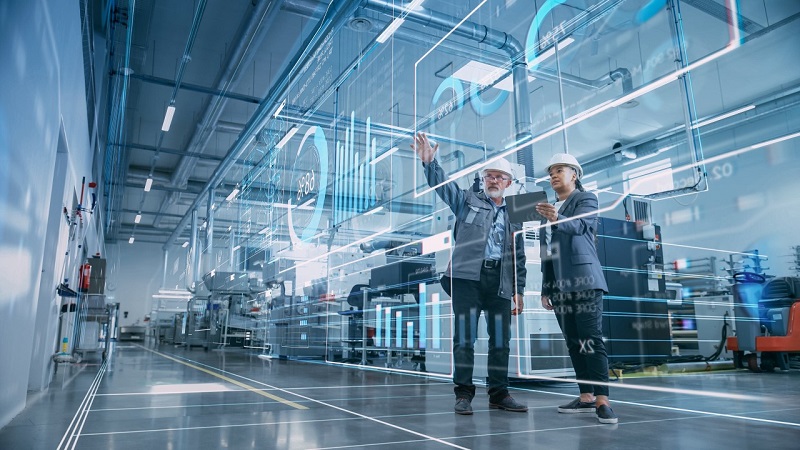
Walk through a state-of-the-art manufacturing plant today, and you will see an impressive display of mechanical choreography. Articulated robotic arms weld structural frames with millimeter precision, autonomous mobile carts navigate warehouse aisles, and continuous diagnostic feeds track every step of the conversion process. It is easy to look at this level of capital investment and conclude that human labor has been rendered obsolete.
That conclusion is one of the most expensive misunderstandings in modern executive management.
Advanced automation does not eliminate the need for human capability; it raises the stakes of human competence. While basic, repetitive physical chores are increasingly handled by software and hydraulics, the operational health of any industrial enterprise still depends on people who understand materials, machine behavior, and system dynamics. As industry adopts higher levels of technical complexity, skilled workers have become the ultimate differentiator between costly downtime and sustained operational excellence.
The Illusion of the Fully Autonomous Floor
The theoretical concept of the “lights-out” factory—a fully automated plant running indefinitely in the dark without human intervention—has captivated business publications for decades. In practice, seasoned plant directors know that physical production is inherently messy. Raw feedstocks vary in temper and moisture, cutting tools dull unpredictably, ambient temperatures alter hydraulic pressures, and communication protocols drop packets.
When an automated cell faults on a modern assembly line, the resulting downtime can cost thousands of dollars per minute. In these high-pressure scenarios, automated diagnostic software can only flag the immediate symptom, such as a localized drop in hydraulic pressure or an axis torque limit breach. It cannot evaluate the complex mechanical context that led to the event.
Resolving that issue requires a technician who can combine telemetry data with sensory reality: feeling for abnormal heat on a motor housing, listening to the pitch of a planetary gearbox, or examining the micro-burr on a stamped edge. The more automated a facility becomes, the more devastating a single unplanned outage is, and the more heavily the business relies on skilled trades to diagnose and correct disruptions quickly.
The Rise of the Hybrid Industrial Technician
The traditional divide between the manual trades and digital systems has collapsed. A generation ago, an industrial maintenance department was neatly compartmentalized into mechanical millwrights, pipefitters, and line electricians. Today, that compartmentalization is an operational liability.
The modern industrial floor requires hybrid technicians who operate at the intersection of mechanical craft and digital systems architecture:
-
Mechatronics fluency: Technicians must troubleshoot high-pressure pneumatics and electrical motor drives while simultaneously interrogating programmable logic controllers (PLCs) and fieldbus networks.
-
Precision digital machining: Contemporary machinists do not merely operate machine tools; they optimize toolpaths in CAM software, manage complex work-holding setups for multi-axis CNC machines, and account for thermal expansion when working with aerospace-grade alloys.
-
Predictive asset management: Rather than following static lubrication schedules, maintenance personnel analyze acoustic emission curves and vibration spectra to rebuild rotating assemblies before catastrophic failure occurs.
These are not entry-level assembly jobs. They are rigorous, cognitively demanding disciplines requiring spatial reasoning, analytical problem-solving, and a deep, tactile understanding of physics in motion.
Tacit Knowledge: What Code Cannot Replicate
Every manufacturing environment operates on two distinct bodies of knowledge: the explicit procedures codified in engineering drawings and standard operating sheets, and the tacit knowledge carried in the muscle memory and instincts of seasoned craftsmen.
Tacit knowledge is notoriously difficult to capture in an algorithm. It is the welder knowing by the tone of the arc and the puddle viscosity that the shielding gas mixture is slightly compromised. It is the toolmaker feeling the precise tension required when seating a stamping punch so it does not crack under load. It is the quality inspector noticing an almost imperceptible distortion in surface finish that points to an imbalance three stations up the line.
When industrial operations dismiss the value of this experiential knowledge, scrap rates surge and project delivery timelines slip. Digital tooling can amplify human precision, but it cannot replace the nuanced intuition gained from years of working directly with physical materials.
The Cost of Institutional Knowledge Drain
Industry faces a generational demographic cliff. As veteran toolmakers, master electricians, and plant mechanics retire, they take decades of unwritten troubleshooting instincts with them. Facilities that fail to capture this expertise find themselves repeatedly solving the same catastrophic equipment failures, burning through consumable tooling at unsustainable rates, and suffering prolonged ramp-up periods on newly installed equipment.
Preserving this institutional memory requires intentional organizational structures. Leading manufacturers are investing heavily in structured apprenticeship frameworks that pair senior journeymen with emerging technicians for extended periods, treating knowledge transfer as a primary operational deliverable rather than an afterthought.
Capital Efficiency and the Automation Paradox
Economists often speak of the automation paradox: as an automated system becomes more capable and efficient, the human contribution becomes more critical, not less. When machines handle ninety-nine percent of nominal operations without error, the remaining one percent of edge cases consists exclusively of complex, multi-variable anomalies.
Modern capital machinery represents substantial financial exposure. A high-speed five-axis machining center or a robotic laser welding cell carries seven-figure acquisition and installation costs. Maximizing return on that capital asset requires keeping it calibrated, properly fixtured, and continuously productive.
An inexperienced or poorly trained operator can cause a tooling crash that racks up tens of thousands of dollars in mechanical damage, ruins expensive casting blanks, and idles downstream operations for weeks. Conversely, an experienced craftsman extracts peak feed rates, preserves tool longevity, and identifies micro-defects before they result in massive customer return batches. Capital equipment is simply an amplifier of the human competence directing it.
Rebuilding the Industrial Talent Pipeline
Securing the future of industrial performance requires completely reframing how organizations recruit, train, and retain technical talent. For too long, cultural narratives have mischaracterized the industrial trades as low-tech, dead-end occupations. In reality, modern industrial work offers intellectually stimulating, highly compensated careers that operate alongside cutting-edge computational tools.
To build a resilient technical workforce, industrial leaders must take three decisive actions:
-
Invest in internal development paths: Relying entirely on recruiting pre-trained talent from competitors is an unsustainable strategy. Businesses must build continuous internal training academies that allow machine tenders and entry-level assemblers to advance toward technical certifications in automation, metrology, and robotics.
-
Modernize regional educational partnerships: Corporate leadership must actively shape curricula at regional vocational schools and community colleges, donating modern equipment and providing guest instructors so students graduate with job-ready skills on current-generation hardware.
-
Elevate the status of plant-floor expertise: Retention is not merely about hourly wages; it is about autonomy and professional respect. High-performing organizations involve their skilled technicians in capital equipment selection, engineering design reviews, and layout planning, recognizing that floor operators understand the practical constraints of production better than anyone else.
Technology will continue to transform the industrial landscape, delivering unprecedented processing speeds, deeper operational telemetry, and tighter manufacturing tolerances. Yet hardware and algorithms remain passive tools. The resilience, adaptability, and ultimate profitability of modern enterprise will always rest in the hands of the skilled workers who know how to build, maintain, and master them.