
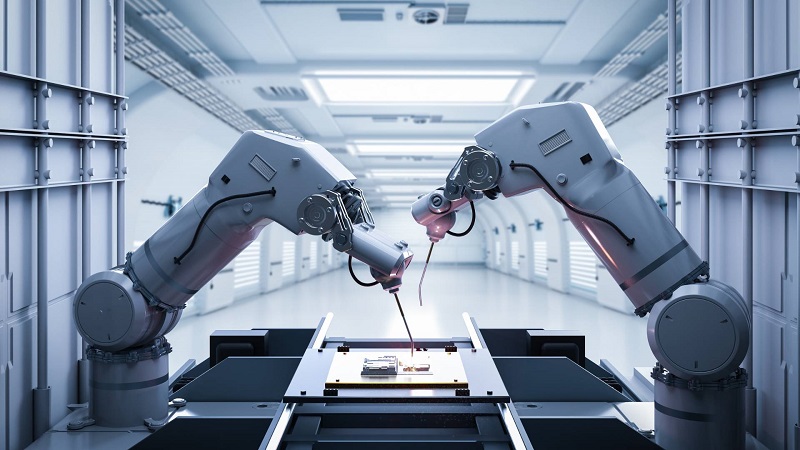
Every major technological leap produces a familiar brand of anxiety. For the past decade, headlines surrounding industrial automation have leaned heavily into apocalyptic predictions: sprawling factories emptied of human life, robotic arms operating in cold, darkened halls, and millions of blue-collar workers permanently displaced by algorithms. It makes for compelling speculative commentary, but anyone who spends time on an actual manufacturing floor or inside a modern distribution hub knows that reality tells a very different story.
Industrial automation is undeniably transforming work, but it is not erasing it. Instead, technology is dismantling traditional job descriptions into discrete tasks. The repetitive, physically grueling, and ergonomically hazardous duties are increasingly transferred to mechanical systems, while the responsibilities left behind—and the dozens of new roles emerging in their wake—demand higher degrees of analytical reasoning, mechanical intuition, and digital literacy. The future of industrial work is not an empty plant; it is a collaborative environment where human expertise and automated machinery operate in lockstep.
Beyond the Replacement Narrative
The fear that machines will completely replace human labor misinterprets the nature of manufacturing and logistics. Physical environments are inherently unpredictable. Raw materials arrive with slight metallurgical variations, ambient humidity alters the curing time of composite resins, conveyor rollers jam under unevenly weighted loads, and software communication protocols occasionally drop critical data packets.
Automated systems, regardless of how advanced their vision sensors or predictive algorithms may be, operate within defined mathematical boundaries. They excel at deterministic tasks—stamping ten thousand uniform sheet-metal panels with consistent tolerances or shuttling standardized pallets across an immaculate concrete aisle. What they cannot do is improvise when something goes sideways.
When an automated machining center flags an unexpected torque spike on a drive spindle, the machine simply halts to protect its tooling. It cannot deduce whether the problem stems from a chipped carbide insert, an inconsistent casting density, or chips packing into the coolant flutes. Resolving that stoppage requires a worker who understands how physical forces behave under real-world conditions. Automation removes routine physical effort, but it dramatically raises the cost and importance of operational decision-making.
The Emergence of the Hybrid Industrial Technician
As physical assets become digitized, the traditional boundaries separating maintenance crafts, machine operation, and information technology are disintegrating. The assembly line worker who spent an entire career manually fastening bolts or feeding raw blanks into a mechanical press is rapidly transitioning into a technician tasked with monitoring, optimizing, and troubleshooting complex automated cells.
This shift has created a new taxonomy of industrial roles that are far more intellectually demanding and commercially resilient:
-
Automation and Mechatronics Technicians: These specialists bridge mechanical engineering, fluid power, and computing. On any given shift, they may rewire a high-voltage motor contactor, troubleshoot a pneumatic valve manifold, rewrite lines of ladder logic in a programmable logic controller, and recalibrate an optical safety curtain.
-
Process and Data Specialists: Rather than walking the floor with clipboards or manually logging output on paper, modern operators use digital interface dashboards to track real-time telemetry. They analyze cycle times, spindle loads, and thermal drift to make micro-adjustments before a part falls out of engineering specification.
-
Robotics Programmers and Tooling Specialists: The proliferation of collaborative robots has decentralized programming. Instead of requiring a dedicated automation engineer to write complex code for every minor tooling change, line technicians teach robots new paths through direct hand-guidance and intuitive graphical interfaces.
These positions demand continuous cognitive engagement. The workers filling them are not passive spectators; they are systems orchestrators who ensure multi-million-dollar capital investments deliver their projected output.
Erasing Danger While Elevating Human Judgment
One of the most consequential yet underreported benefits of automation is its impact on workplace safety and long-term health. For generations, industrial careers were synonymous with chronic physical wear and tear. Decades of heavy lifting, awkward overhead reaches, and exposure to toxic fumes or deafening noise resulted in severe musculoskeletal disorders and premature retirement for countless skilled laborers.
Modern industrial engineering treats human physical labor as a scarce, valuable resource that should never be wasted on brute physical tasks. Autonomous mobile robots now handle heavy material transport, articulated arms manage high-heat forging unloading, and automated vision systems perform grueling optical inspections under strobe lighting that once strained human eyes for eight hours a day.
By absorbing the physically punishing aspects of the job, automation extends the working life of experienced professionals. A veteran fabricator whose knees and back might have forced an early exit twenty years ago can now apply decades of accumulated material knowledge to overseeing robotic cells, mentoring newer technicians, and designing fixture setups that optimize cell efficiency.
The Skills Mismatch and the Training Imperative
If there is a legitimate crisis facing the industrial workforce, it is not an absence of jobs, but a profound mismatch of skills. Across the country, manufacturing facilities and logistics hubs are desperate to hire, yet thousands of technical postings sit vacant for months at a time. The educational pipeline that once fed trade apprenticeships was dismantled over several decades in favor of a singular push toward four-year academic degrees, creating an acute structural vacuum just as industrial facilities hit peak technical complexity.
Closing this gap cannot happen through traditional recruiting methods alone. Winning organizations are abandoning the expectation that they can simply hire fully trained talent off the street. Instead, they are rebuilding their talent pipelines from within:
-
Structured internal upskilling: Progressive manufacturers are establishing formal training tracks that allow entry-level material handlers and machine tenders to earn industry-recognized certifications in programmable controls, industrial networking, and precision metrology while on the clock.
-
Cooperative vocational partnerships: Industry leaders are directly funding and shaping curricula at regional technical schools, ensuring that students train on contemporary industrial controllers, digital twins, and multi-axis machines rather than obsolete surplus equipment.
-
Institutional knowledge capture: As the senior generation of toolmakers, machinists, and plant mechanics approaches retirement, companies are utilizing spatial computing tools and structured mentorship programs to document tacit troubleshooting techniques before they vanish out the door.
Treating workforce training as a capital investment rather than an overhead expense is rapidly becoming the single greatest differentiator between facilities that flourish under automation and those that struggle with prolonged machine downtime.
Navigating the Next Era of Industrial Work
The transformation unfolding across modern industry is ultimately about agency and capability. The industrial jobs of the coming decades will require less sweat and more strategy. Workers who cultivate a curiosity about how systems interact—who understand that software, sensors, and mechanical steel are interdependent parts of a single organism—will find themselves with unprecedented professional leverage and career mobility.
Automation is not the end of industrial employment; it is the catalyst for its professionalization. As the machines take on the burden of repetition, they leave behind an industrial floor that values adaptability, ingenuity, and precision problem-solving above all else. The businesses that thrive will be those that recognize their automated systems are only as effective as the skilled human hands and minds directing them.