
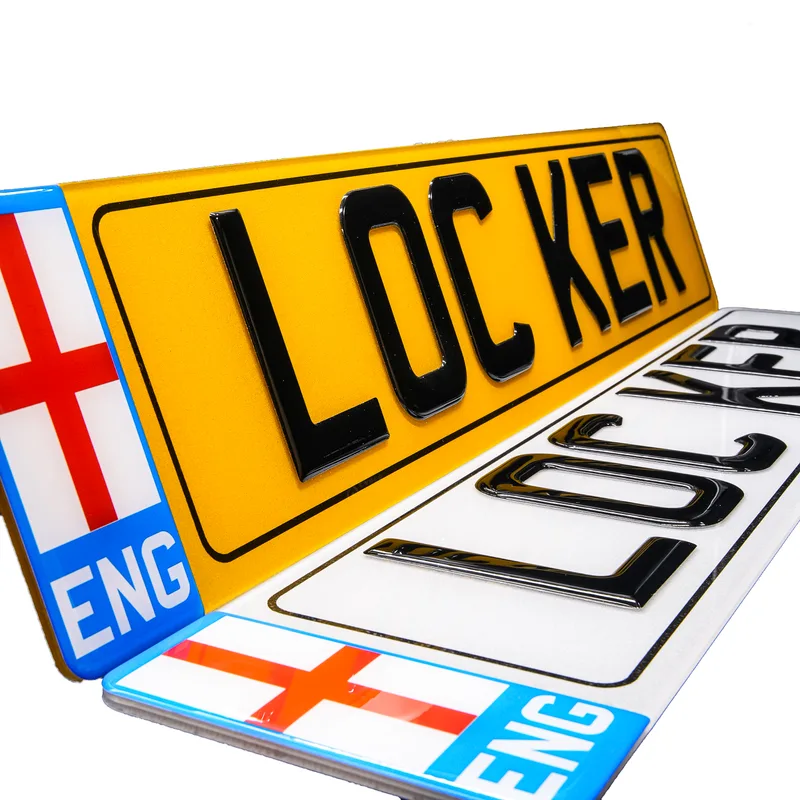
Raised plates have gone mainstream. Walk any car park and you will see domed gel characters on everything from hot hatches to family estates. What has not kept pace is clarity about the law, and a steady stream of social media rumours has left plenty of drivers convinced their plates are about to become illegal.
They are not. 3D Gel Number Plates remain road legal, but only when the finished plate is built correctly. The raised style is not what decides legality. The construction, font, colour and markings are. Here is how to choose a set that looks sharp and still passes without argument.
What a 3D Gel Plate Actually Is
Each printed black character is covered with a clear resin dome that cures hard and rounded. The result is glossy, raised lettering with real depth. It is worth separating the styles people use interchangeably, because they are made differently.
| Style | Construction | Legal position |
| Standard flat | Printed characters, flat finish | Legal when made to standard |
| 3D gel | Printed character under a clear resin dome | Legal when solid black and compliant |
| 4D laser cut | Solid acrylic characters bonded to the plate | Legal when solid black and compliant |
| 4D with gel caps | Acrylic base topped with a gel dome | Legal when solid black and compliant |
| Carbon or shadow effect | Printed tint, two-tone or pattern | Not legal on a road plate |
The pattern is clear. Depth is fine. Anything that tints, shades or two-tones the character is not.
The Standard That Decides Everything
Every plate fitted since 1 September 2021 must meet the current British Standard, BS AU 145e. It governs font, dimensions, spacing, reflectivity, weathering and supplier markings, and it is written so that cameras can read your plate reliably. The requirements for what a plate must and must not display are set out in the official government guidance on number plate rules. Anything a manufacturer tells you has to sit inside that.
For raised plates specifically, the clarification that matters is this: solid black gel or acrylic characters are accepted, because their depth is physical rather than printed. Characters that include clear, coloured, highlighted or carbon-effect sections are not, because the standard requires a solid black character.
A note on the rumours
A proposed amendment that would restrict raised-character plates was put out for consultation and has been discussed widely online. Nothing has been adopted. BS AU 145e remains the current standard, and raised plates remain legal to make, sell and fit. Buy from a supplier who states clearly which standard they build to, and you are insulated either way.
What Makes a Plate Legal
Legal 3D number plates share the same checklist regardless of who made them.
- White reflective background on the front plate, yellow reflective on the rear, with black characters
- Solid black characters throughout, with no tint, shading, two-tone effect or carbon pattern
- The mandatory Charles Wright font at the prescribed character height, width and stroke
- Correct character spacing, with no rearranging, shifting or added bolts to make the registration read as a word or name
- No background patterns, textures, badges, logos or graphics beyond those specifically permitted
- The supplier’s name and postcode, plus the BS AU 145e marking, shown on the plate
- Only a permitted national flag and identifier if you want one, in the correct position on the left
What Makes a Plate Illegal
- Any character that is not solid black, including carbon effect, tinted or highlighted styles
- Non-standard or stylised fonts, however good they look
- Altered spacing or fixings positioned to disguise or change the registration
- Missing supplier details or a missing British Standard mark
- Tinted covers, mesh, acrylic shields or anything placed over the plate
- A plate dirty, faded or damaged enough that the registration is hard to read
The consequences are not trivial. A non-compliant plate can mean a fine of up to £1,000, a failed test, and in some cases withdrawal of the registration number itself.
How the MOT Treats Plates
Testers are not assessing whether your plates look good. Under MOT rules they check a short, practical list.
| What is checked | Pass condition |
| Legibility | Registration readable from the required distance |
| Colour and format | Correct reflective background and black characters |
| Spacing and font | Prescribed layout, no alterations |
| Condition | Not cracked, faded, discoloured or obscured |
| Security | Fitted properly and not loose |
A correctly built gel plate passes this comfortably. Where raised plates fail, it is almost always because the characters were tinted, the font was stylised, or the plate has yellowed from poor curing.
Buying Without Getting Caught Out
These are the practical steps that separate a good purchase from an expensive mistake under current UK road rules.
- Buy from a DVLA Registered Number Plate Supplier, and expect to prove your name, address and entitlement to the registration
- Have your V5C or equivalent documentation ready, since a supplier who does not ask for it is not following the rules
- Ask which British Standard the finished plate is built to, and expect the answer BS AU 145e
- Confirm the characters are solid black with no clear or coloured layers
- Check the plate size suits your car, since squeezing a registration onto a short plate breaks the spacing rules
- Ask about UV stability, because cheap gel yellows within a couple of summers
- Keep the receipt, which is useful if a plate is ever questioned
Getting the Look Right
Within the rules there is still plenty of room to make a plate distinctive.
- A permitted national flag and identifier on the left adds character without touching the characters themselves
- A coloured border is allowed within the rules and frames the plate neatly
- Standard or short plate sizes change the proportions, provided spacing stays legal
- Gloss versus satin finish on the gel changes how the plate reads in daylight
- Matching front and rear properly matters more to the overall look than any single feature
Looking After Them
- Wash with soapy water and a soft cloth rather than a pressure washer at close range
- Avoid solvent-based cleaners, which dull the resin
- Check the fixings after winter, since road salt loosens them
- Replace rather than repair a cracked plate, because a repaired plate will not meet the standard
FAQs
Are 3D gel number plates legal in the UK?
Yes, when the finished plate meets BS AU 145e with solid black characters, the correct font and spacing, and the required supplier markings.
Will 3D gel plates pass an MOT?
Yes, provided they are compliant, legible and in good condition. Raised construction on its own is not a reason to fail.
What is the difference between 3D and 4D plates?
3D uses a resin gel dome over a printed character. 4D uses solid acrylic characters bonded to the plate. Both must meet the same rules.
Can I have a carbon effect finish on the characters?
No. Characters must be solid black. Carbon, tinted and two-tone styles are show-use only.
Final Word
Choosing plates is simpler than the internet makes it sound. Depth is legal. Decoration on the characters is not. Pick a registered supplier, insist on solid black characters built to the current British Standard, keep the spacing and font untouched, and you get the finish you wanted with nothing to explain at the roadside or the test station.