
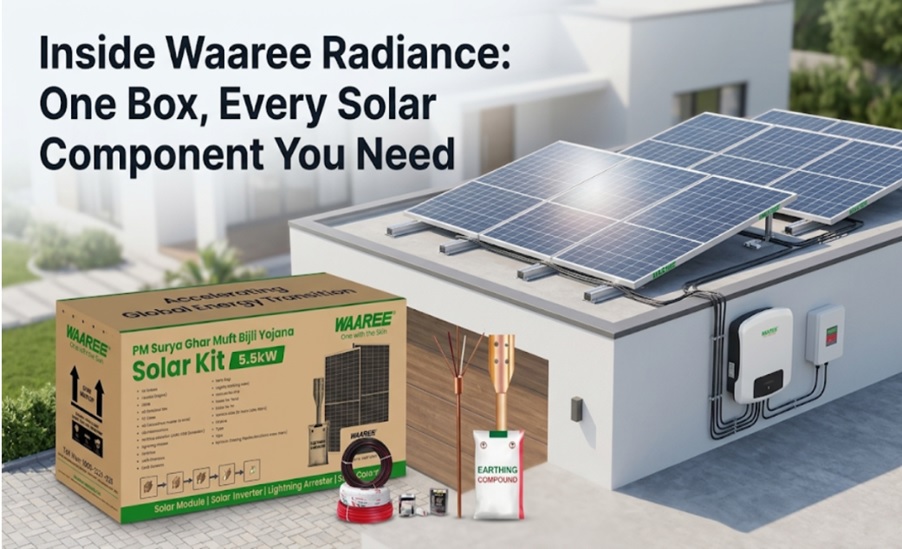
Most people who start researching rooftop solar on their own hit the same wall eventually. You find a good panel, then realise you need an inverter rated correctly for it, then a junction box, then protection equipment, then cabling, and suddenly you’re coordinating five different purchases hoping they all actually work together. Waaree built Radiance specifically to remove that headache.
What’s Actually Inside the Box
The Radiance 3.2 kW configuration ships as a complete 9-component package. That includes the bifacial TOPCon DCR modules (BiN-08 series, rated 560 to 570 Wp), a single-phase on-grid inverter, DC and AC distribution boxes fitted with surge protection devices and MCBs, MC4 connectors, earthing equipment, and the cabling needed to connect everything. Nothing is sourced separately and hoped to match; it’s pre-engineered as one unit from the factory.
Pricing typically falls in the ₹1.3 to 1.42 lakh range before subsidy, and the system qualifies for support under PM Surya Ghar Muft Bijli Yojana, which can bring the effective cost down meaningfully for eligible homeowners.
Where the Modules Actually Come From
Many solar kits consist of panel production from subassemblies, which are usually obtained elsewhere. Waaree, on the contrary, goes the way of backward integration; thus, it produces products that go further down the supply chain than mere assembly of ready components. The company operates its own solar cell production up to 5.4 GW and is constructing an integrated ingot and wafer facility in Nagpur with an estimated cost of ₹6,200 crore.
That implies higher responsibility for the quality of products throughout the entire process, without having to rely on third parties as suppliers for key components. At the same time, the modules of the company have maintained Tier 1 certification for 39 consecutive quarters, according to BloombergNEF, RETC, and Kiva PVEL, all being leading authorities in solar testing worldwide. Furthermore, Waaree maintains the largest retail network among Indian solar brands, consisting of more than 1,000 authorized dealer stores across the country.
Why the Panel Technology Matters More Than You’d Think
The bifacial TOPCon modules used here aren’t just a spec sheet upgrade. Because they capture light on both the front and back surface, Waaree states these panels can pull in up to 20 percent more usable sunlight compared to standard modules, translating to roughly 3 percent better performance overall. In practical terms, that’s meaningful extra generation from the same rooftop footprint, which matters a lot if your roof space is limited.
The Warranty Backing It Up
One thing worth checking before buying any solar kit is what happens after year one. Radiance modules come with a 12-year product warranty alongside a 30-year power output warranty, while the inverter itself carries an 8-year warranty. That’s a fairly strong safety net for a home investment meant to last decades.
How Power Actually Moves Through the System
During daylight hours, the panels generate DC electricity, which the inverter converts to AC power for immediate household use. Since this is a grid-tied configuration, any surplus you’re not using can be exported back through net metering, where your local DISCOM supports it. It’s worth being upfront about one limitation, though: this specific setup doesn’t provide backup during a grid outage on its own. For that, Waaree also offers a Radiance-Lite hybrid version with an integrated LFP battery, built for homeowners who specifically want power continuity during outages, not just daytime savings.
Protection Isn’t an Afterthought Here
A detail that often gets overlooked in DIY solar setups is electrical protection. Radiance’s DCDB and ACDB units come built-in with surge protection devices and MCBs, guarding the system against voltage spikes and electrical faults, rather than leaving that as something to source and install separately later.
Who This Actually Suits
This configuration works well for homeowners doing a straightforward rooftop, single-phase, grid-connected installation, without needing battery backup right away. If your household consumption sits in the range that a 3.2 kW system typically covers, and your roof gets decent, mostly unshaded sun exposure, this is likely a sensible fit. Larger households or those with higher consumption might want to look at the 4.5 kW or 5 kW configurations in the same Radiance lineup instead.
Things Worth Checking Before You Order
Before committing to any capacity, it helps to look at your last few electricity bills to understand actual monthly consumption, confirm how much shadow-free roof space you realistically have, and check that your existing electrical setup can accommodate the new connection. If backup power during outages matters to you, that’s the point where the hybrid Radiance-Lite version becomes worth considering instead of the standard on-grid kit.
Where to Actually Buy One
Radiance kits are listed on Waaree’s own online store as well as Amazon, both offering the same bundled configuration with GST invoicing and typical shipping windows of one to three weeks depending on location.
For anyone tired of piecing together a solar system component by component, Radiance offers a genuinely simpler alternative, one built by India’s largest solar module manufacturer, with the compatibility and warranty backing already sorted out before it ever reaches your rooftop.